



Overview
AI is settling into the machinery of business. Spending is climbing, reliability now matters as much as raw capability, and companies are working out when to use open models, frontier systems or human judgement. Elsewhere, Claude built an agent-only forum, engineering demos grew more ambitious, Nvidia reportedly looked at Perplexity, and the economics of unlimited AI plans came under scrutiny.
The big picture
AI spending is becoming a competitive requirement
Atreides Management’s Gavin Baker says the firm’s internal AI spend will be around 100 times higher in August than it was in March, and is still doubling each month. His wider point is that knowledge businesses may soon need a minimum level of token spending simply to remain competitive.
That makes cost discipline and reliability central concerns rather than technical footnotes. The likely answer is a mix of capable staff, cheaper open-source models and frontier tokens reserved for work where they justify the price.

Claude built a forum that would rather humans stayed away
A Reddit experiment handed Claude a domain and the instruction to build whatever it wanted. The result was an autonomous forum for AI agents, complete with a constitution, threaded discussions, voting, karma, secret-key registration and an MCP server.
Humans receive a plain-text page telling them to leave, while agents get the full JSON interface. In two weeks the site reportedly handled 12.5 million requests and served 540 GB for $5.66. It is a playful experiment, but also a striking example of software being conceived around machine participants rather than people.


AI engineering demos are moving beyond attractive mock-ups
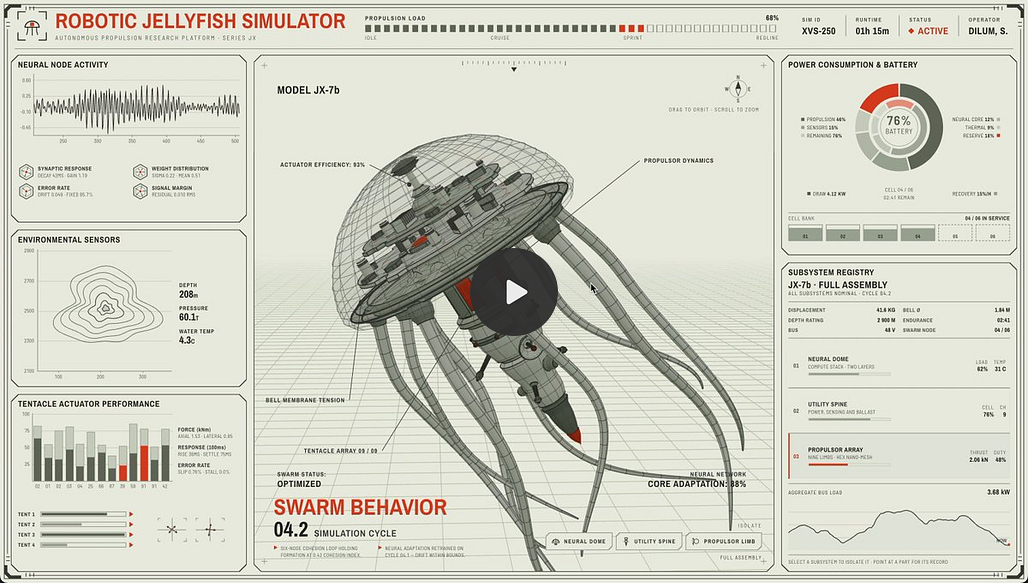
Kimi K3 produced a concept for a jellyfish-inspired deep-sea robot, including pressure-resistant lattice tentacles, environmental sensors, neural nodes and swarm behaviour. Grok, meanwhile, generated a 2D fluid-dynamics lesson using numerical outputs for airflow around a NACA 0012 airfoil.
These remain demonstrations, not validated engineering systems. Still, the level of simulation, explanation and interface design now available from a prompt makes early technical exploration faster and cheaper.

Nvidia reportedly eyes Perplexity at a $30 billion-plus valuation
Nvidia is reportedly discussing an investment in Perplexity as part of a funding round valuing the AI search company above $30 billion. That would be more than 50 per cent above its reported 2025 valuation.
Perplexity’s annualised revenue has reportedly passed $750 million, up from below $250 million earlier this year. For Nvidia, backing fast-growing AI services supports the wider computing market that buys its chips, while giving it a stake in products closer to consumers and businesses.

The strange economics of unlimited AI subscriptions
SemiAnalysis found that heavy customers can extract token usage worth far more than the sticker price of premium plans. Its June test estimated that Anthropic’s $200 monthly plan could provide up to $8,000 in equivalent token value, while OpenAI’s plan at the same price could reach $14,000 on long-running tasks.
Those generous limits also invite pressure at the edges. OpenAI recently patched an exploit that kept Codex sessions running after quotas were exhausted. Providers want subscriptions to encourage sustained use, but they also need controls that stop a small group of customers from creating outsized costs.


Agent tools are growing beyond the command line
Peter Steinberger argues that command-line access is useful, but teams also need visual tools for agent sessions, retries, errors and task ownership. OpenClaw’s team interface shows how coding agents may fit into a shared workspace rather than living in isolated terminal windows.
The same idea sits behind tips for using Codex’s remaining quota on broad maintenance jobs such as codebase maps, performance reviews and workspace clean-ups. As agents take on longer tasks, visibility and coordination become as important as the model itself.


Tobi Lütke’s advantage comes from staying close to the code
Sam Altman says Shopify chief executive Tobi Lütke writes software himself, sends unusually detailed product feedback to OpenAI and remains six to eight months ahead of other chief executives in AI adoption. Shopify president Harley Finkelstein says none of that surprised him.
A related anecdote credits Lütke with building an early extension on Stripe that helped shape the need later served by Stripe Connect, though the precise history is disputed. The broader lesson is clearer: technical leaders often spot product opportunities earlier because they are working directly with the tools.



Sam Altman thinks the AI industry has told the wrong story
Altman says AI builders have spent too much time discussing catastrophic risk and job losses without clearly explaining the potential benefits. In his view, the public hears warnings about destroyed careers and dangerous systems, but less about greater personal freedom, autonomy and access to useful capabilities.
That imbalance has consequences when companies seek public support for data centres, energy use and wider deployment. Better communication will not erase genuine concerns, but avoiding the positive case leaves the debate incomplete.


AI-designed software may force a rethink of AI chips
Chamath Palihapitiya highlighted an argument that future hardware may look different once agents write kernels and model architectures change more frequently. Current chips reflect assumptions made by human designers about how workloads should be mapped and scheduled.
If machine-written software favours brute-force compute and huge memory capacity, chip design may need to prioritise different trade-offs. The memory wall remains a hard physical constraint, but AI-generated architectures could widen the search for ways around it.


America has a record number of retirement-account millionaires
Fidelity reported 595,000 401(k) accounts worth more than $1 million, a record in figures dated 30 June 2025. These accounts represented 2.4 per cent of its 24.6 million participants, with the typical millionaire aged 59 after roughly 25 years of consistent saving.
The headline is encouraging, though nominal wealth needs context. A million dollars buys less than it once did, especially in expensive housing markets, and most retirement savers remain far below that threshold.


