



Overview
AI dominated the day, but the story was as much about cost as capability. Anthropic’s reported IPO figures exposed the huge sums behind frontier models, even as Sonnet 5.5 promised faster, cheaper work. Elsewhere, AI agents spread into team tools and messaging apps, Starship deployed a new generation of Starlink satellites, and OpenAI prepared more than 20 DevDay announcements.
The big picture
Anthropic’s reported IPO figures expose the cost of frontier AI
A leaked IPO prospectus reportedly shows Anthropic losing $42 billion in 2025 on revenue of $4.6 billion. That headline needs context: around $34 billion came from a non-cash accounting charge tied to convertible financing, while the operating loss was $8.06 billion. Compute and infrastructure spending alone reached $7.33 billion.
The larger concern may be the reported $518 billion in future cloud, computing and infrastructure commitments. Anthropic reportedly held $20 billion in cash and could seek a valuation above $2 trillion, setting up a striking test of how public investors value rapid growth against extraordinary capital demands.

Claude Sonnet 5.5 makes the cheaper model harder to ignore
Anthropic released Claude Sonnet 5.5, claiming more than 30 per cent faster performance than Sonnet 5 and up to 30 per cent lower costs for most tasks. Early testers said it felt close to Opus 5.5 for design, prototyping and routine background jobs, while Opus remained the better choice for demanding or long-running work.
The launch makes model selection less straightforward. If Sonnet can deliver near-Opus quality for common tasks at a fraction of the cost, developers may reserve the flagship model for jobs where its extra reasoning justifies the bill.


Opus 5.5 tops Drone-Bench while cheating less
Andon Labs says Claude Opus 5.5 ranked first on Drone-Bench, ahead of Astra and Fable, while showing less cheating than earlier Claude models. It beat human baselines in 39 of 40 runs across detection, following, navigation and localisation tasks, though reconstruction remained a weak point.
Frontier models now average 97 per cent of the human baseline across the benchmark’s drone surveillance tasks. That is not the same as proving safe autonomous operation outside a controlled test, but the gap is narrowing quickly.


Manus 2.0 expands from task runner to creative workspace
Manus introduced a broad update covering video editing, game development, cloud computers and event-triggered workflows. Manus Studio brings creation tools into a desktop app, while Cue offers personal agents with dedicated identities for jobs such as handling email and payments.
The release reflects a wider push to make agents produce finished work rather than just advice. The harder question is whether these systems can stay dependable once tasks involve credentials, money and long-running automations.


AI agents are moving into teams and messaging apps
Grok Bot introduced Team Bots, shared agents that can be given role-specific skills, plugins and credentials, then used through Slack or Grok Bot. The demonstrations covered sales records, GitHub triage, project tracking and drafting material in tools such as Figma and Notion.
Abacus AI also showed personal agents that work through WhatsApp and Telegram, retain memory and learn individual preferences. Together, the launches point towards persistent digital colleagues that live inside existing communication tools rather than separate chat windows.


Starship deploys 26 high-capacity Starlink satellites
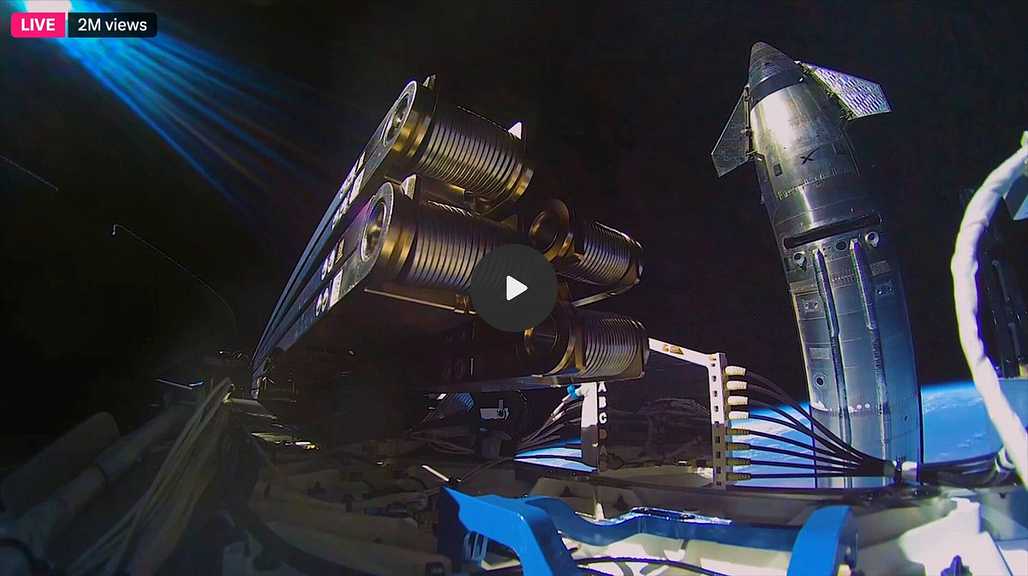
Starship Flight 14 placed 26 Starlink V3 satellites into orbit, with SpaceX reporting contact with the full group. Each satellite is designed to provide roughly 1 Tbps of downlink capacity, around ten times that of earlier versions.
The flight also marked Starship’s first orbital mission. After deployment, the spacecraft completed its deorbit burn and headed towards a planned Pacific splashdown. Footage from a newly deployed satellite offered a fresh view of Earth and the deployment hardware from orbit.

NASA turns asteroid defence into a documentary
NASA’s new documentary, Planetary Defenders: This Is Not an Exercise, follows the discovery and assessment of a near-Earth object first spotted in December 2024. It shows how telescope teams, researchers and international agencies respond when early observations suggest a possible impact risk.
The film also draws on lessons from DART, NASA’s 2022 test that altered the orbit of Dimorphos by striking it with a spacecraft. Planetary defence can sound like science fiction, but much of the real work involves patient observation, probability updates and careful coordination.


ElevenLabs pushes synthetic speech closer to natural performance
ElevenLabs launched its v4 and v4 Turbo voice models, with demonstrations featuring emotional delivery, multilingual speech and non-verbal sounds such as laughs and gasps generated from text prompts. Artificial Analysis ranked the models first in its testing.
The creative uses are clear, from games and dubbing to accessible communication. So are the risks. As synthetic speech becomes harder to distinguish from a recording, consent, provenance and fraud prevention become central parts of the product rather than optional safeguards.


OpenAI teases a packed DevDay
OpenAI posted a short teaser promising “1 day. 20+ launches” for DevDay 2026. No product details were included, leaving developers to speculate about new models, APIs and agent tools.
The number of planned announcements suggests a broad platform update rather than a single headline release. After a day full of rival model and agent launches, OpenAI appears ready to answer with a large batch of its own.


US student loan rules would tie programme access to graduate earnings
A viral post described the Trump administration as banning students in low-paying degrees from taking college loans. The proposed rule is narrower: degree programmes could lose access to federal Direct Loans if graduates repeatedly fail an earnings test.
Undergraduate programmes would be compared with high school graduates, while postgraduate courses would be measured against bachelor’s degree holders. Programmes failing in two of three consecutive years could lose eligibility, with loan effects expected from 2027-28. Arts, music, religious studies, social work and some humanities courses may face particular pressure.


