



Overview
Today’s conversation centred on constraints. Developers are debating how to guide coding agents, benchmark whether models can learn over time and manage the hidden costs of long sessions. Elsewhere, higher interest rates are rewriting financial assumptions, public posts are becoming unofficial support tickets, and realistic synthetic video is making ordinary clips harder to trust.
The big picture
Higher rates are rewriting the economic rulebook
A 10-year Treasury yield of 5.24 per cent marks unfamiliar territory for Americans under 45. Mortgages, company funding, asset prices and household borrowing were all shaped by decades of falling rates. That backdrop has now changed, just as concerns about employment are growing.
Roon called it the end of the Great Stagnation. Signüll offered the darker reading: higher borrowing costs paired with a weak jobs market could undermine nearly every major financial goal held by the average household.


Chess exposes the limits of continuous model learning
Peter Gostev’s benchmark gives models 200 chess games against Stockfish, allowing them to choose the difficulty and keep notes but not consult an engine. The aim is to test whether a model can build its own learning process and improve through experience.
The early results are modest. GPT-6 Astra finished at 1,400 Elo after declining from stronger opening levels, while Claude Opus 5.5 reached 1,570 after 95 games with little clear progress. Models can describe learning plans, but turning those plans into lasting gains remains a separate challenge.


AI coding may favour more abstraction, not less
Matt Pocock argues that abstractions can narrow the choices available to coding agents. Paired with strict lint rules, a good internal framework steers an agent towards acceptable patterns while reducing the amount of code it needs to read and produce.
This runs against the idea that agents perform best when given raw code and maximum freedom. Pocock’s case is that carefully designed boundaries now matter more, partly because agents can help repair an abstraction when its original design proves weak.

Rust faces a new argument about build speed
Charlie Marsh suggests that Rust’s future may depend less on its safety model and more on its compile times. If coding agents become dependable at manual memory management, developers may place greater value on fast iteration and reconsider lower-level languages such as C.
That remains a large assumption. Rust’s guarantees still catch serious errors before deployment, but AI coding changes the cost calculation. A language designed to protect human programmers may face different competition when agents write and revise much of the code.


Claude Code users are watching the cache clock
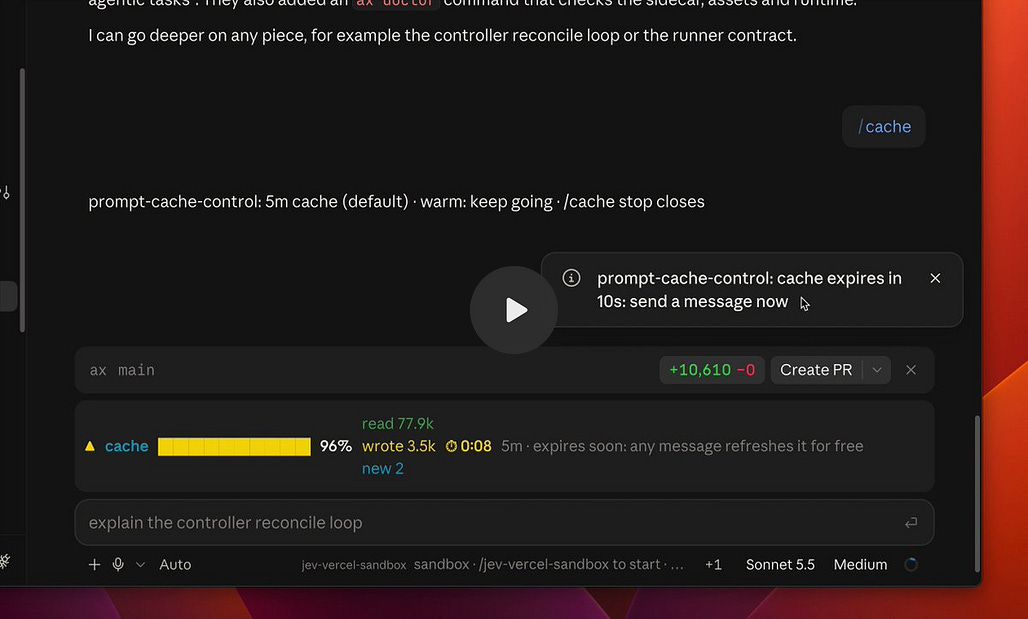
Daniel San highlighted a Claude Code mod that tracks the five-minute prompt cache, warns before expiry and displays how many tokens were read from cache or written afresh. Keeping that cache active can extend long sessions without repeatedly rebuilding the full context.
It is a small tool built around an increasingly important concern: agent costs depend not only on the model and prompt, but also on how context is stored and reused.

A week in Play Store limbo reaches Google’s leadership
After OpenClaw’s Android app spent more than a week awaiting review, Peter Steinberger asked publicly whether anyone at Google could help. Sundar Pichai and Android ecosystem president Sameer Samat responded directly and promised to investigate.
The exchange showed the imbalance in app distribution. Most developers must rely on standard support queues, while a widely seen post can turn an unresolved ticket into an executive issue within hours.

A spectacular beach stunt fails the reality check
Charly Wargnier shared a clip of a woman sprinting up a steep curved ramp, completing an extreme aerial flip and landing safely. Grok judged it to be AI-generated, pointing to the implausible climb and descent.
The deeper story was the uncertainty around the clip. Synthetic video no longer needs to look perfect to spread. It only needs to remain plausible for the few seconds before viewers repost it, argue about it or ask another model to verify it.


Starlink makes in-flight Wi-Fi feel ordinary
Jason Calacanis tested Starlink on a United flight from Austin to Los Angeles and came away eager to see it on routes to Japan and the Middle East. United now has the service on more than 600 aircraft, with broader fleet coverage planned through 2027.
The notable part is how quickly fast in-flight internet is moving from novelty to expectation. Once passengers can work, call and stream reliably on domestic flights, older satellite connections become harder to excuse on long-haul routes.

Chamath closes the books on a long venture cycle
Chamath Palihapitiya shared a Q2 update as Social Capital’s older venture funds approach the end of their lives. Across the 2011 to 2018 vintages, cumulative net TVPI stands at 3.2 times and net DPI at 2.7 times, with each fund ranked in Cambridge Associates’ top quartile.
His main lesson is to focus reporting on cash returned rather than flattering paper valuations. Venture funds take years to mature, but net DPI provides a blunt test of whether apparent gains have become money that limited partners can use.


The perfect .com may simply need a better name
Paul Graham’s advice to founders is simple: if the desired .com is unavailable, keep thinking. The assumption that there is a single ideal domain can trap a company into an expensive purchase or a weaker name.
URLs may carry less weight than they once did, thanks to search, apps and direct links. Even so, Graham’s broader point holds: naming constraints can prompt better ideas rather than force a compromise.


