



Overview
SpaceX’s reported Starship catch dominated the day, with engineers, investors and tech leaders celebrating a major test of rocket reuse. Robotics brought another striking claim about training costs. Closer to everyday life, ChatGPT is getting a travel lead, AI assistants are facing the test of repeat use, and a Seattle flat sale offered a reminder that ownership costs extend beyond the purchase price.
The big picture
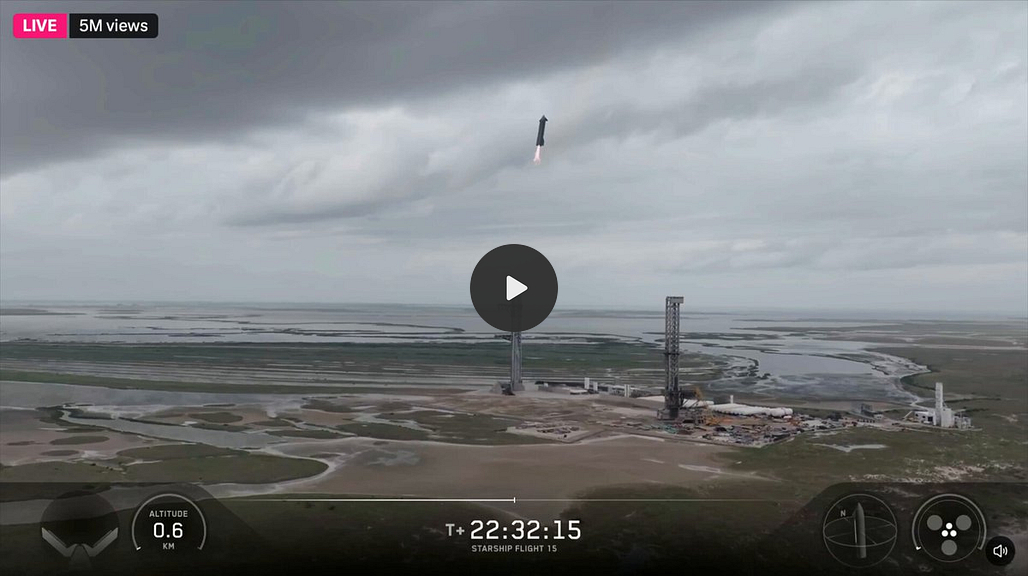
SpaceX reportedly catches Starship after orbital flight
SpaceX said Flight 15 was coasting in orbit with its launch tower ready for a catch. Later posts from Michael Baylor, Sawyer Merritt and Andrew Ross Sorkin reported a successful return, with Sorkin saying Starship had completed 14 orbits. Merritt described it as the first recovery of a conventional orbital rocket upper stage.
The distinction is important: recovering the spacecraft that reaches orbit is a different challenge from catching a booster. It is a substantial step towards full reuse, though a successful catch does not yet establish how quickly or cheaply the vehicle can fly again.

Ros Shinkle reports a dramatic cut in robot training time
@make_robot_go says training a whole-body robot controller has gone from a week on 128 GPUs to three minutes on a single GPU. If those figures describe comparable tasks, that would make locomotion experiments accessible to a much wider group of researchers.
The post does not name the method or give benchmark conditions, so the comparison needs more detail. The practical question is whether those gains hold across different robots and survive the move from simulation to physical hardware.

Francis Davidson says he now leads travel at ChatGPT
Francis Davidson says OpenAI acquired his company this week and that he now leads travel on ChatGPT. He is asking what people want the app to handle when planning a trip. The post does not name the acquired company or announce specific features.
Travel is a demanding test for an assistant: a pleasant itinerary is useful only if the opening hours, transport connections and prices are right. Keeping those details current will count for more than producing a persuasive list of places to visit.

Robin Ebers explains why Grok Bot kept his attention
Robin Ebers says Grok Bot is the assistant he has continued using. He paused ChatGPT Dots over bugs, refusals and repeated approval requests, and says Claude Duet has so far done little after an encouraging start.
This is a personal account, not a comparative test, but the complaints are concrete. An assistant can impress in a demonstration and still lose its place in someone’s routine if it needs too much supervision. Permission checks need to protect people without making ordinary tasks feel like paperwork.

Harrison Chase puts agent goal design under scrutiny
Harrison Chase shared work with @mgarimella on lessons from actively, arguing that agents need carefully designed goals as they take on more independent work.
A broad instruction such as “increase sales” leaves plenty unanswered: which customers to contact, what claims are acceptable and when to stop. The goal needs boundaries and a clear definition of success, not just an outcome to chase.

Guillaume B compiles decades of Elon Musk interviews
@GuillaumeAIinSF says he has gathered Elon Musk interviews dating back to 1998 into a bilingual website. The collection reportedly contains 651 videos, 508 hours of footage, 4,492 quotations and 418 predictions checked individually.
An archive like this could make it easier to compare a memorable promise with its original wording and deadline. The prediction checks deserve their own scrutiny, particularly how they treat partial successes, revised dates and ambiguous claims.

Daye reports a 46% loss on a Seattle flat
According to @dayecapital, a flat at 121 Stewart Street sold for $525,000 this month after being bought for $980,000 in October 2022. That is a $455,000 price loss, before transaction costs. The post also cites monthly homeowners’ association dues of $1,236.
A single sale cannot describe Seattle’s housing market, but it shows how expensive a long exit can become. The property was reportedly first listed in August 2023, leaving years of ownership costs between the initial asking price and the eventual sale.


Nicki Sanders points to maintenance work in FAA disruption
@nickisanders reports that the FAA found no evidence of a cyberattack or a connection to SMART in the recent ground stop. Her account points instead to L3Harris crews replacing an end-of-life copper line.
The supplied post cuts off before explaining the full sequence, so it does not establish precisely what failed. It does put maintenance procedures, rather than speculation about an attack, at the centre of the account.


Gergely Orosz accuses The Economist of failing to credit his work
Gergely Orosz says The Economist redrew and renamed his Trimodal compensation diagram without linking to his original work, even after he raised the issue. He says he has told the publication never to use his material again.
The supplied material contains his account, not a response from the publication. His complaint draws a clear distinction between changing how a chart looks and crediting the research behind it. Redrawing an idea does not make its source irrelevant.


Canoopsy compares an iPhone Duo with the original iPhone
@Canoopsy shared a camera comparison labelled “iPhone Duo” versus the first iPhone from almost 20 years ago. It drew the largest audience in this batch, with nearly five million views.
A side-by-side image can make a long period of technical progress easier to grasp than a specification sheet. Without capture settings or test conditions, though, it is a visual comparison rather than a controlled measure of camera performance.


