

Overview
Today had two clear threads: multimodal AI moving from demos to developer tools, and the messy human bits that sit around it, from quality in AI-written code to bot-filled social platforms. There was also a dose of old-fashioned hardware spectacle, with SpaceX teasing Flight 12 testing and defence tech hype colliding with reality.
The big picture
AI is getting easier to build with and harder to trust at the edges. On the builder side, embeddings and coding agents keep compressing the work needed to ship useful systems. On the social side, the same acceleration risks flooding platforms with synthetic behaviour, while founders and product teams are reminded that growth still comes down to people choosing to stay.
Google’s Gemini Embedding 2 pushes multimodal search into the mainstream
Google is putting a proper stake in the ground with Gemini Embedding 2: text, images, video, audio, and PDFs in the same vector space. The interesting part is not the buzz, it’s the practical implication for teams doing retrieval, content understanding, and cross-media search without stitching together separate models.
Preview access via the Gemini API and Vertex AI also hints at how quickly this is meant to land in real products, not just research blogs.

Claude Code vs Codex, a grounded comparison from someone who actually uses them
@Hesamation’s write-up is the sort of agent comparison people want: not vibes, but what happens when you hand these tools a real pipeline and judge the output. The headline is that Claude Code seems to hold up better on longer, messier tasks, while Codex still earns points for clean, configurable engineering.
The takeaway is refreshingly human: tooling choices are about fit with your workflow, not a single scoreboard.

Benchmark culture continues, with GPT-5.4 getting the “special” label
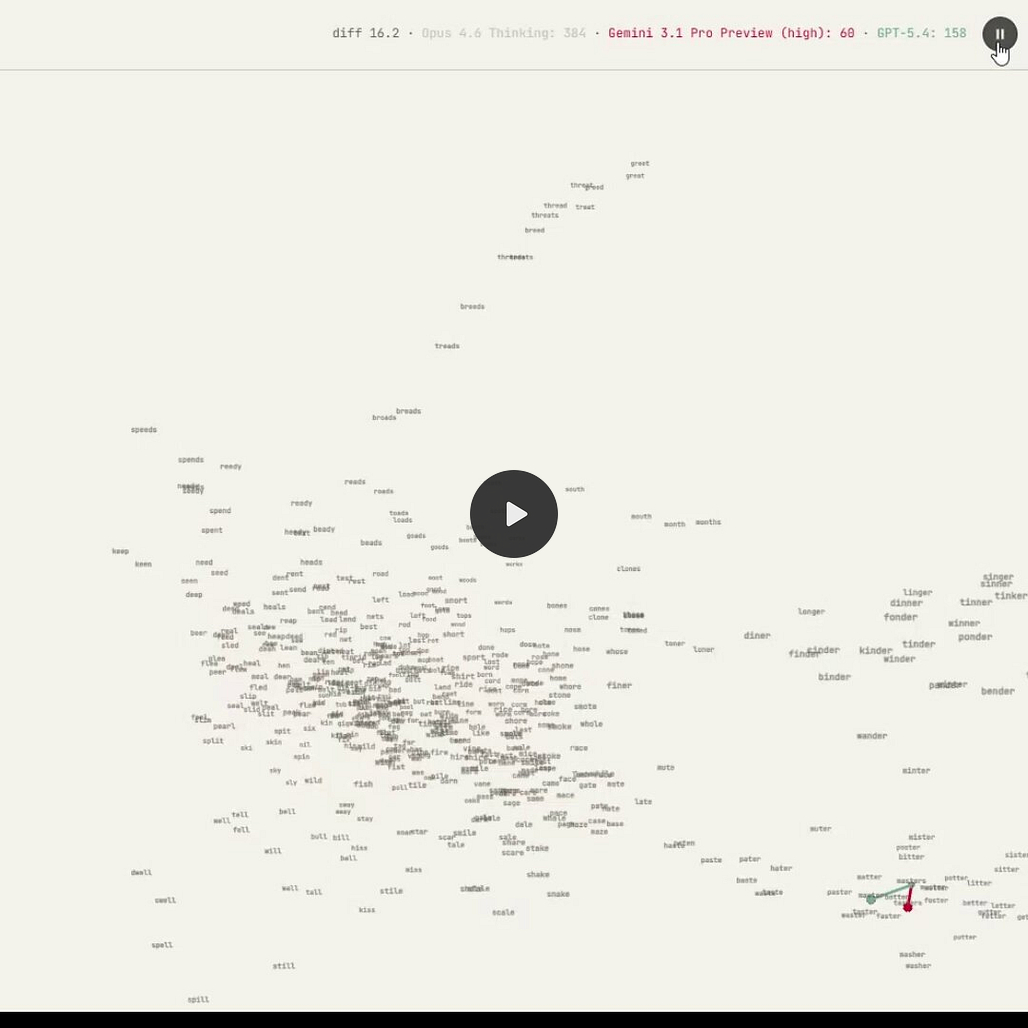
LisanBench is making the rounds as another attempt to measure planning and vocabulary under constraints, and the claim here is that GPT-5.4 explores a wider space of possibilities than Opus 4.6 or Gemini 3.1 Pro. Whether you buy the framing or not, people are hungry for tests that feel less gameable than the usual leaderboard loop.
It’s also a reminder that “reasoning” debates are still being fought with charts, videos, and a fair bit of interpretation.


“Fighting slop” is becoming a serious software practice
@swyx surfaced a small set of rules from OpenCode that land because they are boring in the right way: don’t ship features just because you can, leave the code better, fix process over adding more. That is the sort of discipline LLM-assisted teams need if they do not want to wake up buried in brittle glue code.
It’s a useful counterweight to the current rush to automate everything that can be automated.


Hermes Agent vs OpenClaw, the open-source agent debate rolls on
@gregisenberg’s question captures the mood: are we seeing genuine progress in open agents, or just a new name and a new demo loop? Hermes Agent is being framed as more mature, with memory and skill-building, plus safety choices like isolation, but the scepticism is healthy given how quickly “autonomy” gets oversold.
For most people watching, the real test will be boring reliability, not a flashy terminal video.


Meta and the fear of bot-filled platforms gets louder
@birdabo’s post is a joke with teeth: the idea of millions of autonomous agents buying, selling, posting, and scamming across Facebook, Instagram, and WhatsApp hits a nerve because it feels plausible. Even without any new acquisition, people already experience the bot problem as a daily annoyance.
If platforms cannot separate human intent from automated behaviour, trust becomes the scarce resource, and it is hard to win back once lost.



Naval’s take, AI drains moats built on scarcity
@naval summed up a growing founder anxiety in a single sentence: AI is going to drain a lot of moats. The implied follow-up is where people are landing now, that defensibility moves towards judgment, relationships, distribution, and accountability, the things you cannot copy-paste from a model output.
It is a clean framing for why “we have secret sauce” sounds weaker every month.

Churn as the harshest kind of feedback
Paul Graham’s reminder is blunt and useful: slow growth is bad, but slow growth because people try your product and then leave is worse. Churn is not a marketing problem, it’s a product problem, and it means users made it past the threshold and still decided it was not worth it.
This is the sort of metric founders should stare at before polishing their next launch post.

Starship Flight 12 teasing, the theatre of iteration
NASASpaceflight captured SpaceX doing what SpaceX does: load propellant, kick on the deluge, and let everyone argue whether it was a static fire attempt or a spin prime. Even when nothing lights, the process is public enough that the community treats it as an event.
It also underlines how much the Starship programme now runs on rapid ground testing as a form of progress in itself.


The “miniature fighter jet” clip, defence tech hype meets scrutiny
@CollinRugg’s viral clip about Mach Industries’ Viper shows how quickly language outruns reality in defence tech. People hear “fighter jet” and imagine a certain class of aircraft, while the details point to something closer to a VTOL cruise-missile-style system.
The comments split neatly between excitement about lower-cost capability and suspicion that this is branding doing too much work.