



Overview
Today’s feed has that familiar mix of big technology promises and messy human reality: batteries that charge in minutes, space logistics that keep science ticking over, and fresh attempts to make AI tools easier to use and govern. Alongside it, there’s a budget warning from Uber’s coding rush, a high-profile Apple leadership handover, and a run of politics and media stories that remind you how quickly narratives can harden before the facts do.
The big picture
Two threads run through nearly everything here. First, speed, whether it’s charging, shipping experiments to orbit, or churning out code with AI. Second, trust, in institutions, in statistics, in security controls, and in leaders being honest about what’s happening behind the scenes. The practical question for the week ahead is whether the systems around these breakthroughs can keep up: budgets, safety controls, governance, and plain old judgement.
CATL claims minutes-not-hours charging for LFP batteries
CATL’s latest Shenxing LFP announcement is the sort of spec sheet that makes you blink, with sub-4-minute charging to 80 percent being the headline. If those numbers hold up outside the stage and across real-world pack sizes, it tightens the gap between cheaper LFP chemistry and the premium experience people associate with top-end EVs.
The cold-weather angle matters too. Fast charging in freezing conditions is where plenty of battery promises get awkward, so CATL leaning into -30°C performance is a clear attempt to answer the “fine, but what about winter?” question.


NASA lines up the next ISS cargo run for mid-May
Resupply missions rarely feel dramatic, but they are the quiet backbone of the International Space Station. NASA says the next delivery of science and equipment is set for no earlier than 12 May, carrying experiments alongside the essentials that keep the crew living and working in orbit.
It’s also another reminder of how routine commercial space has become. The remarkable part is not that it’s happening, but that it happens so often we only notice when it doesn’t.


Euphony turns messy AI logs into something you can actually read
OpenAI Developers introduced Euphony, an open-source tool for visualising chat data and Codex session logs. It’s aimed at the unglamorous work of debugging and review, where raw JSON and scattered metadata can turn into hours of squinting.
If you spend time evaluating outputs, auditing sessions, or trying to understand why an agent did what it did, a browsable interface with filtering and translation is the kind of small improvement that can save your week.


Google’s Stitch opens up DESIGN.md to standardise design rules for agents
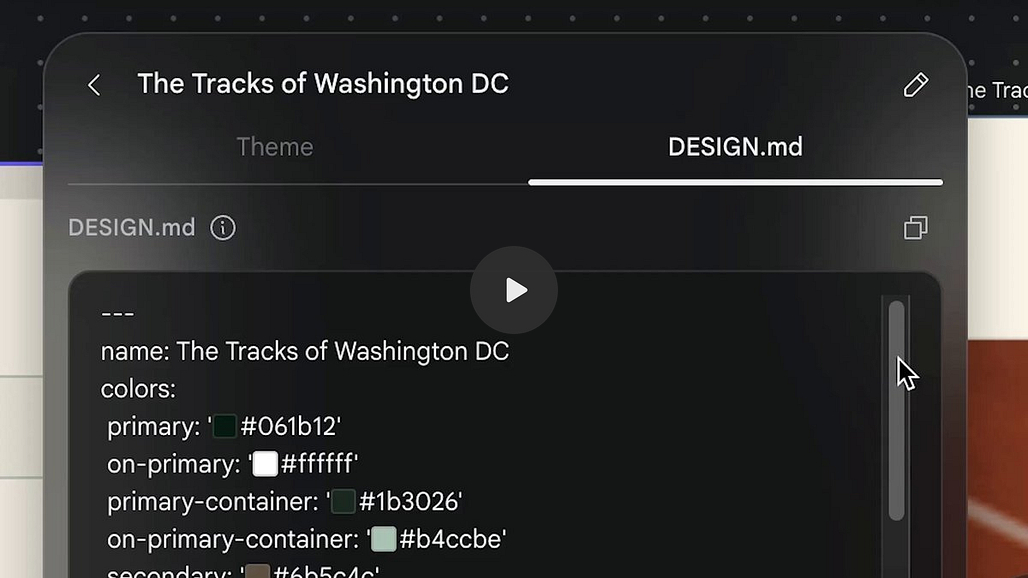
Stitch by Google has open-sourced a draft specification for DESIGN.md, pushing the idea that design intent should be portable, explicit, and readable by both humans and machines. The pitch is straightforward: stop relying on vibes and memory for UI rules, and give tools a shared reference they can check against.
It’s also a bet on community standards. If teams converge on a common format for tokens, components, and accessibility constraints, it becomes easier to move between projects without re-litigating colour, spacing, and typography every time.

Uber’s AI coding bill arrives early
Polymarket reports Uber has already burned through its 2026 AI budget after pushing rapid adoption of vibe-coding tools. It’s a tidy story with an untidy implication: if AI tools become part of daily engineering, token-priced usage can run ahead of budgeting habits that were built for licences and headcount.
The more interesting question is what comes next, not whether Uber spent the money. Do firms renegotiate pricing, build internal tooling, ration usage, or accept that “cost per engineer” now includes an AI line item that looks more like cloud spend than software procurement?

Tim Cook frames Apple’s CEO handover as a handoff, not an exit
Tim Cook posted a public note of thanks and introduced John Ternus as the incoming Apple CEO. The tone is deliberately calm, aimed at signalling continuity and confidence rather than rupture.
Leadership transitions at Apple are always read like tea leaves, but this one is being presented as a planned succession with Cook still nearby as executive chairman. Investors might care about the org chart, but the cultural test is whether product decisions keep their internal coherence.


Anthropic’s “too dangerous” model reportedly exposed by guessable URLs
JoshKale describes a chaotic security story: Anthropic said Mythos was too dangerous to release, then a small group reportedly gained access by guessing the endpoint based on naming conventions. If true, it is a depressingly familiar failure mode, where the most advanced part of a system is guarded by the least imaginative controls.
Even without full details, the lesson is plain. If you are treating a model as sensitive, the operational security has to be as serious as the rhetoric.


A viral reminder that “healthy” minds often run on optimism
Nicholas Fabiano, MD shared a blunt line: mentally healthy people are often delusionally optimistic. It points back to a long-running idea in psychology that mild positive illusions can support resilience, motivation, and wellbeing.
It’s a useful counterweight to the online habit of treating cynicism as intelligence. Accuracy has its place, but so does the capacity to keep going when the spreadsheet says you probably shouldn’t.


Indictment claims about the SPLC collide with the basics of legal language
Aaron Rupar posted a clip where Acting AG Todd Blanche discusses an indictment alleging the Southern Poverty Law Center paid informants linked to extremist groups. The moment that caught fire is the back-and-forth over whether this is an allegation or something more settled.
It’s a familiar media trap: indictment language is strong, and people talk as if it’s a verdict. The gap between “charged” and “proven” is where public trust tends to get lost.


Virginia redistricting passes, and the reaction is instant outrage
Geiger Capital says Virginia redistricting has passed and claims it redraws the state from 6D-5R to 10D-1R. Whatever your politics, the speed of the response shows how raw the map issue is, because it looks like the rules of competition changing mid-game.
It’s also a reminder that “democracy” arguments often turn into “my side” arguments once the lines are on the table. The fight is rarely about abstract fairness, it’s about who gets power next.


