
Overview
Today’s feed bounced between hard data and human judgement: Tesla hit a huge FSD mileage milestone, finance officials warned about AI-driven cyber crime, and the markets got a jolt from talk of a GameStop bid for eBay. Elsewhere, there was scepticism about health labels, a practical push to automate open source maintenance, and a few reminders that old things, from tractors to Omega watches, can still earn trust the straightforward way.
The big picture
A pattern ran through the day: proof beats promises. Whether it’s autonomy stats, security warnings, or a decades-old tractor doing loop-the-loops to win over farmers, the mood is moving away from vibes and towards receipts. Even the softer posts, on family and work or vintage watches, were really about what holds up over time.
Tesla’s FSD counter clicks past 10 billion miles
Tesla says its fleet has now driven over 10 billion miles on FSD (Supervised), a scale that’s hard for any competitor to match. Beyond the headline, the point is feedback loops: more miles mean more edge cases, more training data, and faster iteration, at least in theory.
It also raises the obvious question people keep circling back to: when the supervised qualifier disappears, what standard of proof will be considered enough?


Treasury flags AI risks to bank accounts
Polymarket surfaced a blunt warning from Treasury Secretary Scott Bessent: people should worry about AI hacking their bank accounts. The detail underneath matters more than the headline, because it frames this as an acceleration of capability, not a distant sci-fi threat.
If this is already a closed-door topic with bank chiefs and regulators, it is a reminder that consumer-grade security habits, and bank-side safeguards, are about to be tested in ways most people do not expect.

GameStop rumoured to be lining up a bid for eBay
The WSJ-sourced chatter: GameStop preparing an offer for eBay at $125 a share, implying a valuation around $55 billion. Even allowing for deal structure and financing details, it’s an audacious mismatch in size, and that’s why it grabbed attention.
Investors are left weighing two different stories: a bold roll-up attempt to become an e-commerce heavyweight, or a headline that reads better than it executes.

A widening political gap between young men and women
Wilfred Reilly shared Gallup trend data suggesting young men have barely moved politically since 1999, while young women have moved sharply more liberal. Whatever you think drives it, the gap itself is now the point, because it shapes everything from dating to workplace culture to elections.
The replies immediately turned into competing explanations (education, social media, incentives), which is usually a sign the numbers have hit a nerve.


Bryan Johnson takes a swing at organic food labels
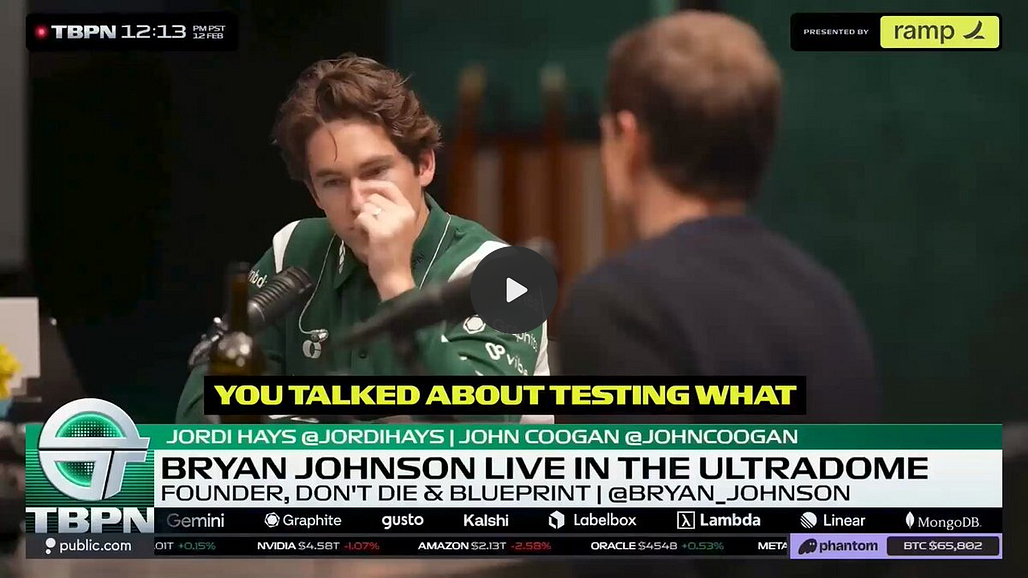
In a clip shared by TBPN, Bryan Johnson argues his testing often shows organic food performing worse than non-organic across multiple measures, calling the label “worthless” as a marketing protocol. It’s a deliberately provocative stance, and it lands because it targets the comforting assumption that organic automatically means healthier.
Even if you disagree, his broader point is hard to ignore: people buy labels when what they really want is measurable outcomes.

Open source maintenance gets an AI janitor
Peter Steinberger introduced ClawSweeper 0.2.0, an open-source tool aimed at maintainers drowning in issues and PRs. The pitch is not magic, it’s coverage: detect, propose, open guarded PRs, review, repair, and merge with sensible checks.
This is the less glamorous side of AI coding tools, and arguably the more useful one, keeping neglected projects from quietly rotting.


The rise of “prompt structure” as a shareable craft
0xMarioNawfal posted a Claude prompt structure for building a personal “voice clone” profile via self-interview prompts and a saved markdown file you can port between models. It’s a snapshot of where everyday AI use is heading: fewer ad-hoc chats, more repeatable setups that preserve taste, tone, and constraints.
People are treating these profiles like personal tooling now, something you tweak and keep, not a throwaway experiment.


A founder’s note on kids and ambition
Blake Scholl wrote about founding Boom Supersonic while raising three children under 24 months, without a supportive partner, and still calling kids a joy rather than a burden. It’s personal, but it also pushes back on a wider cultural script that frames family as incompatible with high-pressure work.
The partner line is the sharp edge here, less inspiration, more practical advice.


Vintage Omega love, with an engineer’s logic
Paul Graham made the case for 1950s Omega automatics: accurate, affordable, and pleasing to live with. It’s not just nostalgia, it’s an argument about maintainability and good design ageing well.
In a day full of AI and finance drama, it was a calming reminder that some purchases are meant to outlast the cycle.


1950s tractor stunts and the lost art of proof
Brian Roemmele shared footage of a tractor doing full loop-the-loops at farm fairs to prove reliability. It’s absurd, but it also makes the point instantly: trust was earned in public, under stress, with no slide deck in sight.
There’s a straight line from that to today’s obsession with benchmarks and live demos. People still want to see the thing work.