



Overview
Today’s feed had two speeds: blistering AI progress on the one hand, and hard questions about infrastructure and trust on the other. We saw a stealth model shoot to the top of OpenRouter, real-time video generation inch towards live production, and a fresh wave of “vibe design” tools making UI mock-ups feel more like a conversation. Meanwhile, energy storage manufacturing hit a landmark in the US, X had another rough day, and geopolitics kept dragging oil and risk back into focus.
The big picture
AI is moving from “better models” to “better workflows”, with new hardware, new agent runtimes, and new ways to turn messy inputs into usable outputs. At the same time, the wider world is pushing back into view: energy supply chains, platform reliability, and the uncomfortable reality that security and incentives are still doing most of the steering.
A stealth model hits number one, and it turns out to be Xiaomi
OpenRouter says the anonymous “Hunter Alpha” model climbed to the top of its leaderboard and did it on sheer usage, not hype. The twist is the identity reveal: it’s reportedly an early test build of Xiaomi’s MiMo-V2-Pro, which says plenty about how frontier teams now prefer quiet launches and clean feedback before the branding arrives.
If the benchmark and cost claims hold up, it also puts Xiaomi firmly in the “serious model shop” category, not just a consumer hardware firm dabbling in AI.


Karpathy gets a deskside supercomputer, and local compute looks tempting again
NVIDIA delivered the first DGX Station GB300 to Andrej Karpathy’s lab, the kind of machine that makes “run it locally” feel plausible for work that used to demand a data centre queue. The point is not just raw performance, it’s iteration speed and control, especially for agent-style research where long runs and frequent tweaks are the norm.
It’s also a neat indicator of where NVIDIA thinks the next wave of builders will sit: not only big labs, but small teams with serious on-site kit.


Real-time video generation drops below 100ms to first frame
Runway previewed a real-time video model trained with NVIDIA, showing HD output that appears instantly, with a reported time-to-first-frame under 100ms. That is a different category from “wait a few minutes for a clip”, it starts to look like live direction, rapid scene testing, and interactive media pipelines that do not stall every time you change a prompt.
Even as a research preview, it hints at a near future where “generating video” is closer to a graphics setting than a render job.


Google’s Stitch pushes “vibe design” into a shared canvas
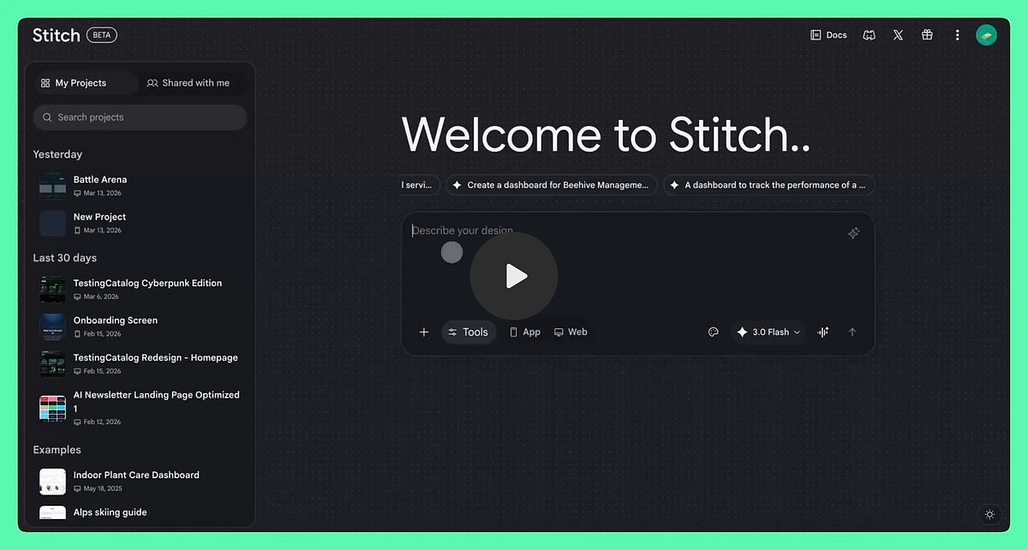
Google’s Stitch is rolling out a new canvas-style experience for “vibe design”, aiming to turn back-and-forth prompting into something closer to spatial editing. The pitch is simple: talk through layout, colour, and components, and get prototypes and code exports without living in design tooling all day.
People are split between excitement and eye-rolling, but the direction is clear: UI design is being treated as an agent conversation, not a file format.


Demis Hassabis joins the Stitch chorus
When Demis Hassabis posts about a product like Stitch, it reads as more than a casual share. It is a signal that Google and DeepMind want these agent-led creative tools to feel mainstream, not experimental side projects, and that they think “design by instruction” is ready for wider use.
Whether that helps designers or irritates them will depend on how controllable and predictable the outputs become once real teams try to ship with it.


Claude Code’s SKILL.md trick amazes people, and worries them too
Nick Dobos highlighted a Claude Code feature where SKILL.md files can include shell command calls that inject outputs into prompts. It’s clever: you can pull diffs, comments, and repo context straight into an AI workflow without manual copying.
The immediate follow-up concern is obvious though: anything that runs commands becomes a security story, particularly if “skills” can be shared, reused, or pulled from places you do not fully trust.


Agents without bash, swapping scripts for JavaScript sandboxes
Dax Raad says they have been experimenting with dropping bash from agent workflows and letting agents write JavaScript instead, then running it in a secure execution environment. The appeal is cross-platform behaviour and fewer footguns, plus a cleaner path to constrained execution.
It is also a small cultural change: instead of agents “driving a terminal”, they start “writing small programs”, which may end up being easier to audit and reproduce.


The US can now supply domestic energy-storage systems, per Bloomberg
Unusual Whales flagged Bloomberg reporting that US production capacity can now cover 100% of domestic energy-storage systems. That is a huge jump in a short time and it matters for grid reliability, industrial policy, and the scramble to support data centre growth.
The caveat is that supply chains do not end at final assembly, and key inputs still pull the story back towards China and other concentrated sources.

Philips, the brand that outlived the business people remember
@levelsio reminded everyone that much of what people buy with a Philips logo is no longer made by Philips. The company has steadily sold off consumer divisions and leaned into healthcare, while the name lives on through licensing deals.
It’s a useful reminder that “brand” and “manufacturer” have been drifting apart for years, and that nostalgia can hide some sharp corporate reinvention.


Middle East oil infrastructure fears, and the knock-on effects
Balaji laid out a blunt case against attacks on oil infrastructure, warning that it risks a global economic hit and secondary crises that show up in everything from food prices to industrial inputs. Even if you disagree with his framing, the through-line is hard to ignore: energy chokepoints still dictate the baseline for global stability.
He also points to the uncomfortable flip side, that crises accelerate alternatives, but usually at a steep human and economic cost.


