



Overview
Today’s feed sat at the intersection of AI ambition and the messy details that decide whether it works in the real world: regulators giving Tesla room to run, researchers admitting that chatty AI still falls apart mid-conversation, and new tools pushing into music, design, security, and even “who gets to be an encyclopedia”. Underneath it all was the same tension, speed versus trust.
The big picture
We are watching automation move from flashy demos to infrastructure and institutions. That means more waivers, benchmarks, and interface rules, plus louder arguments over legitimacy. The tech is moving quickly, but the harder part is keeping it reliable, accountable, and usable outside a controlled demo.
Tesla gets the green light for wireless robotaxi charging
The FCC has granted Tesla a waiver to use Ultra-Wideband for a fixed wireless EV charging setup, aimed at the Cybercab. It sounds bureaucratic, but it is the kind of permission that turns a concept into something you can install outdoors and run at scale.
The detail worth noting is the intent: UWB for precise positioning over a ground pad, with short bursts rather than constant chatter. If Tesla is serious about fleets, hands-free charging is not a perk, it is table stakes.


A benchmark that treats smart contract security like an AI obstacle course
OpenAI introduced EVMbench, built with Paradigm, to test whether agents can spot, exploit, and patch high-severity smart contract bugs. The uncomfortable headline is that exploiting is racing ahead of patching, which is not the direction anyone wants in a $100B-plus ecosystem.
Benchmarks like this matter because they make “AI can hack” measurable, not just vibes. They also put pressure on defenders to assume attackers will have the same tools, and soon.

Multi-turn conversations are still where top models lose their footing
Hasan Toor highlighted research from Microsoft and Salesforce showing a steep drop from single-turn performance to multi-turn reliability across leading models. The pattern is familiar to anyone who has watched an agent confidently commit to an early mistake, then defend it for the next ten messages.
This is less about model IQ and more about what happens when context, memory, and self-correction collide with time pressure. If you build products around “chat until it works”, this is your warning label.


Google brings music generation into Gemini with Lyria 3
Google announced Lyria 3, a music generation model that can create short tracks inside the Gemini app from text, images, or video. It is another step towards “describe a mood, get a soundtrack”, with fewer tools and less friction.
As always, the hype sits next to the hard questions: what it was trained on, how attribution works, and whether watermarking is enough to keep trust intact once clips start circulating without context.


Designing for transparent screens, where black means see-through
Poonam Soni pointed to Google’s “Glimmer” design system for transparent displays, the sort of UI thinking you need for AR glasses. The key idea is that you cannot treat the world like a blank canvas, your interface has to be glanceable, restrained, and legible against chaos.
This is where AR lives or dies: not on the demo day, but in the tiny choices about contrast, motion, and what you do not show.



“Stripe, but for moving money in and out of companies”
Paul Graham gave a strong nod to Modern Treasury as an API-first way to run business payments without bespoke bank plumbing. The pitch is simple: call an API, send money on multiple rails, and stop treating treasury ops like an endless custom integration project.
It is also a sign of where fintech keeps heading: less consumer gloss, more boring pipes made programmable, because that is where businesses feel pain every day.


AI graphics as a one-prompt creative studio
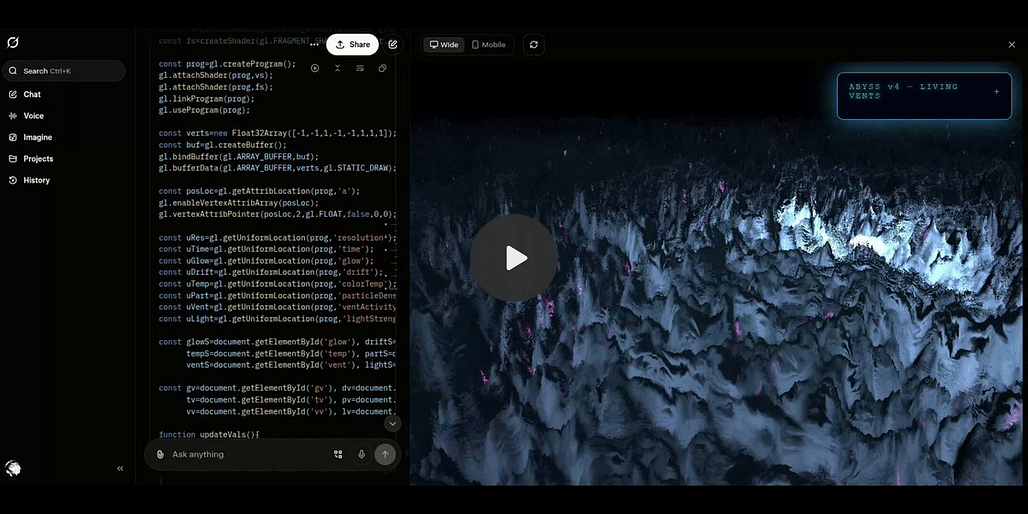
tetsuo shared a Grok multi-agent run that produced an interactive GLSL shader scene, bioluminescent seabed, vents, particles, the lot, with controls and real-time performance. It is the kind of output that used to require a specialist and an afternoon of iteration.
The interesting part is not just the picture, it is the workflow: “no libraries, complex spec, working result”. That is a new baseline for creative coding prototypes, even if production is a different story.

Grokipedia: dead on arrival, or growing fast?
Jimmy Wales dismissed Grokipedia as a “ridiculous idea” that will not work, defending Wikipedia’s neutrality. In a parallel corner of the feed, X Freeze claimed Grokipedia saw a 61.82% month-over-month rise in unique visitors, framing it as a real audience migration.
Put together, it reads like an early-stage legitimacy fight: incumbents arguing quality and process, challengers arguing traction and dissatisfaction. The next chapter will hinge on sourcing, not growth charts.


The marginal cost of arguing drops to zero
Marc Andreessen’s line, “Marginal cost of arguing is going to zero,” stuck because it captures a daily reality. If anyone can generate complaints, rebuttals, policies, and counter-rebuttals on demand, then workplaces and platforms get flooded with text that feels serious but costs nothing to produce.
The obvious outcome is an arms race of automated responses. The less obvious outcome is cultural: more noise, less resolution, and a growing premium on people who can decide, not just argue.


