



Overview
AI is moving beyond chat boxes and into the physical and commercial world. Nvidia is locking down scarce memory, SpaceX is chasing vast data centre capacity, Claude Code can now sketch interfaces, and independent builders are giving agents persistent roles. Elsewhere, GitHub suffered another serious outage, NASA prepared its next major telescope, and leaked footage offered a glimpse of camera-equipped AirPods.
The big picture
Nvidia secures a sizeable share of next year’s HBM
Nvidia has reportedly reserved 35% to 40% of global high-bandwidth memory supply for 2027. UBS estimates put its share of total demand near 41%, down from roughly 58% in 2026 as Google, AMD and other chipmakers expand their own accelerator programmes.
The lower percentage does not mean Nvidia is buying less. HBM capacity at SK Hynix, Samsung and Micron remains tight, with much of the next two years already covered by long-term contracts. Securing enough memory for Rubin systems gives Nvidia room to pursue plans for 24GW to 30GW of rack-level AI hardware shipments worldwide.


SpaceX’s 10GW compute target starts to look plausible
SemiAnalysis argues that SpaceX may have found enough sites to reach 10GW of AI data centre capacity by the end of 2027. The plan rests on local gas generation, which could avoid some of the grid connections and permitting delays holding back conventional projects.
Recent construction lends the claim some weight. Capacity at Southaven reportedly grew from 0.5GW to 1.7GW within months, while the company has been sourcing turbines and modular equipment at speed. The target is still formidable, but it is no longer easy to dismiss as a distant aspiration.


Claude Code adds editable interface design
Anthropic’s new /design skill lets Claude Code create editable UI artboards from a prompt and the surrounding codebase. Developers can compare options, adjust a chosen layout and ask Claude to turn it into working code from the same environment.
The research preview is available through the CLI and desktop app for paid plans. It brings visual exploration much closer to implementation, though early replies also raise familiar concerns about access, rate limits and whether core model behaviour should take priority over new tools.


Hermes turns AI agents into persistent colleagues
Nous Research has brought Bot Mode back to the Hermes Agent desktop app. Instead of starting disposable sessions, people can create named specialists with separate jobs, models, memories, skills and avatars.
Those bots can talk to each other through mentions and group chats, divide projects and retain their own state over time. The model resembles a small team more than a collection of prompts, with each agent carrying context from previous work.


GitHub’s outage renews questions about its foundations
GitHub suffered a widespread outage on Monday, with high error rates affecting the website, API, Git operations, archive downloads, pull requests and Copilot. Service recovered after several hours, but the incident added to months of reliability complaints.
Gergely Orosz suggested that old architectural choices may now be difficult to unwind, despite GitHub having strong engineers focused on the problem. For developers whose deployments and daily work depend on the platform, repeated failures are becoming harder to treat as isolated events.


An AI built its own mosquito camera test
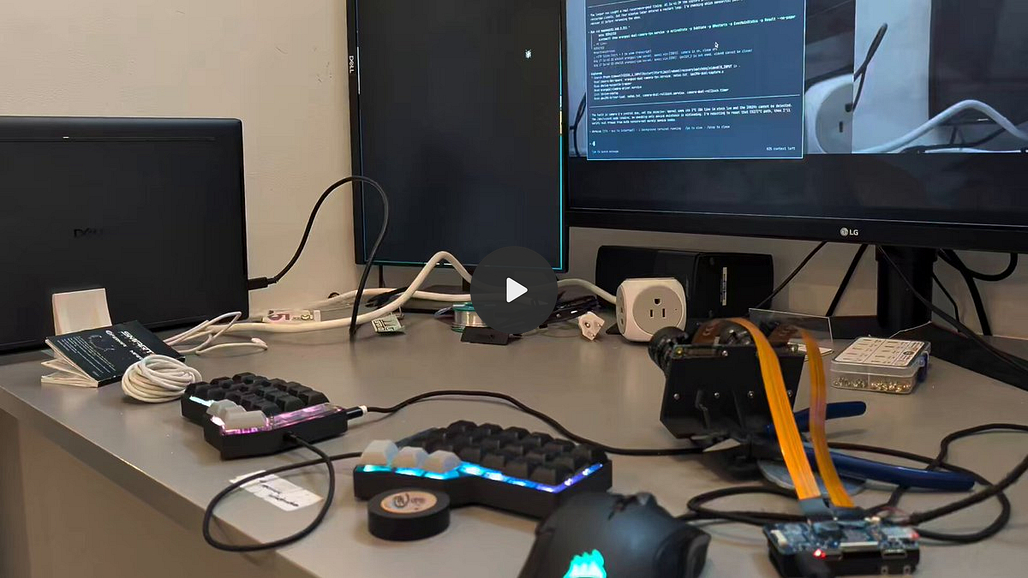
While robotics engineer kache was away from his desk for four days, an AI agent created a fake mosquito animation and a calibration routine for his stereoscopic camera. The test only required the camera to be pointed at a monitor.
It is a small but useful example of agents handling experimental setup rather than merely writing code. The wider project aims to track mosquitoes in three dimensions as part of a mosquito-killing robot, though hardware work still demands close attention and repeated physical testing.

Leaked footage points to AirPods with cameras
Mark Gurman shared purported footage from macOS 26.7 showing camera-equipped AirPods working with Apple’s Visual Intelligence system. In the short clip, a wearer picks up a book while the earbuds appear to capture its cover for recognition or information retrieval.
If the footage reflects a forthcoming product, AirPods could become visual AI accessories rather than audio devices alone. Cameras worn near eye level would give Apple’s software ongoing context without requiring someone to hold up an iPhone.


NASA’s Roman telescope is nearly ready for launch
The Nancy Grace Roman Space Telescope is due to launch in under two weeks aboard a Falcon Heavy from Kennedy Space Center. Its 2.4-metre mirror matches Hubble’s diameter, but its field of view is around 100 times wider.
From the Sun-Earth L2 point, Roman will survey billions of galaxies, study dark energy and search for thousands of exoplanets during its five-year primary mission. Named after NASA’s first chief of astronomy, the telescope reached Florida ahead of schedule and remains under budget.


Uncrustables becomes a billion-dollar lesson in convenience
The frozen crustless peanut butter and jam sandwich began with two North Dakota fathers selling lunches to a local school district in 1995. Smucker’s bought the product for $1 million three years later, and annual sales have now reached $1 billion.
Trung Phan sees an opening for a healthier competitor built around simpler ingredients and strong branding. Smucker’s is responding to demand with a $1.1 billion Alabama factory and new meat, cheese and taco products, showing how far a basic school lunch idea can travel when convenience is hard to beat.


Levelsio is pairing digital income with physical assets
Indie maker levelsio says he is buying houses and land to diversify ahead of possible economic disruption from AGI. The move may seem at odds with his nomadic reputation, but he says property ownership has not reduced how often he travels.
It reflects a broader concern among technology entrepreneurs: online businesses may produce strong cash flow, yet tangible assets offer a different kind of exposure if AI changes the value of software, labour or digital products.


