



Overview
Today was a tug of war between “make it smaller and run it anywhere” and “make it bigger and fund it forever”. We saw serious progress on compact models and edge hardware, while the Claude Code leak kept sparking fresh angles on IP, open-source momentum, and how fast software can be re-made once it’s out in the wild. On top of that, a new Gmail quality-of-life tweak landed, and the usual April 1 pranks reminded everyone not to take release notes at face value.
The big picture
The centre of gravity keeps moving towards two extremes at once. On the ground, more capability is being squeezed into smaller models and cheaper setups, the sort you can run on a phone or a modest local box. At the top, the capital and compliance machinery around frontier AI is accelerating too, with safety agreements, mega-rounds, and agent products aimed straight at regulated work. The gap between “I can run this offline” and “this needs an army of lawyers” is starting to feel like the story.
Liquid AI bets on small agents that can actually use tools
Liquid AI’s LFM2.5-350M pitch is simple: stop treating sub-1B models as toys. The focus here is reliable extraction and function calling at a size that normally falls apart, with the added point that quantised it can sit under 500MB for tighter devices and offline workflows.
If the benchmarks hold up in real deployments, this is part of a broader pattern: agent-style behaviour is no longer reserved for the largest models, which changes what “local-first” can mean for document processing and lightweight automation.


PrismML comes out of stealth with a “1-bit” 8B model
PrismML’s launch is another reminder that compression is now a first-class research lane, not an afterthought. An 8B model squeezed down to around a gigabyte, with claims of big speed and energy wins, is the sort of thing that makes on-device inference feel less like a party trick and more like a product plan.
The scepticism in the replies is healthy, because “true 1-bit” claims are easy to market and harder to prove. Still, the direction is clear: people want strong models that fit where the work happens.


Apple-approved eGPU driver opens up Mac AI setups
Tiny Corp says Apple has approved its eGPU driver for Thunderbolt and USB4 Macs, covering both AMD and NVIDIA. That matters because it lowers the friction for a practical “Mac plus external GPU” workflow, without the usual system tweaks that put off anyone who is not keen on tinkering.
It is also a nice counterpoint to the edge-model story: sometimes the quickest win is not a smaller model, it is simply making more compute usable.


Receipt photos to structured data, the unglamorous win that counts
Hasan Toor’s demo with Perceptron AI is about a painfully real problem: messy receipts that defeat standard OCR. The appeal is straightforward, take photos of crumpled paper and get clean line items and totals out the other end, ready for CSV and categorisation.
This is the kind of “boring” automation that can save hours, because it targets the friction points where humans still retype and double-check.


The Claude Code leak, and how fast the internet re-builds software
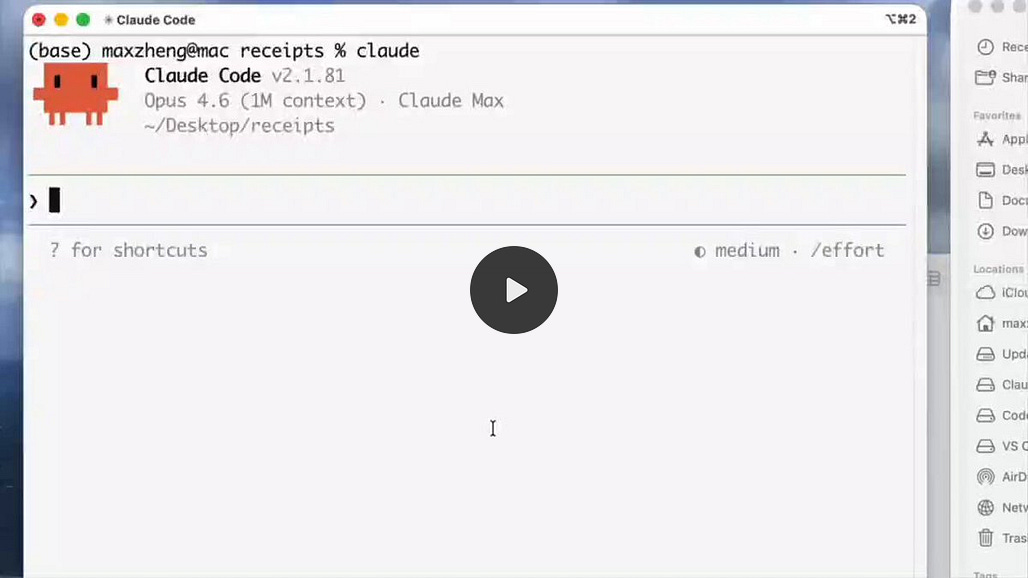
Yuchen Jin framed the leak’s aftershock in the starkest terms: once code is public, AI tools can help re-express it into a new codebase at speed, including wholesale language ports. That is not the same as training weights leaking, but it does change the practical enforceability of “closed” tooling when the scaffolding can be replicated overnight.
It is also a cultural moment, because the community response is not just mirroring, it is iterating, translating, and shipping variants as if that is the default.


What the leak reveals about Claude Code’s design
Aakash Gupta took the more useful angle: treat the leak as a window into how a modern agentic CLI is put together. The interesting bits are the coordinator patterns, permissioning, command surface, and the practical UI decisions that make these tools usable day to day.
Even if Anthropic patches the packaging mistake, these architectural lessons are now common knowledge, and they will show up in competitors and forks in weeks, not years.

DMCA scattergun meets confused bystanders
Daniel San’s post captures the messy end of enforcement: takedowns that appear to hit forks of Anthropic’s public repos, not just mirrors of leaked source. When legal responses go broad, it is easy to spook the wrong people and create extra noise.
In a world where code spreads instantly, the clean-up matters almost as much as the original mistake, because it shapes developer trust.


OpenClaw gets a practical field guide, costs and all
Lenny Rachitsky flagged Claire Vo’s guide to OpenClaw, pitching it as a start-to-finish manual that includes the bits people normally hide, such as real API spend and the security foot-guns that show up once agents have file access and tool permissions.
The mood across agent tooling is maturing: fewer “look what it can do”, more “here is what it costs, here is what can go wrong, here is how to run it without panicking”.


AI for fraud and compliance moves from pitch decks to production
Y Combinator’s Founder Firesides episode spotlights Variance coming out of stealth with a $21M Series A, aimed at risk work like fraud detection and identity checks. This is a reminder that “agents” are not just for coding, they are being pointed straight at messy, high-stakes queues inside large firms.
It is also a quiet theme of the day: lean teams using coding agents to scale output, while the product itself is another layer of automation watching for scams and abuse.


Gmail finally lets you change your address without burning the old one
Sundar Pichai announced a long-requested tweak: you can update your @gmail.com username while keeping the old address as an alias. It is a small feature with an outsized emotional payoff for anyone still stuck with a teenage inbox name on job applications.
The gradual rollout and regional limits will annoy some people, but it is the sort of account-level change Google usually avoids, which makes it notable.


