



Overview
Today’s posts centre on AI doing more than answering questions: building interactive worlds, managing desktop distractions and coordinating work across laboratories. The harder questions sit alongside the demos. What should customers pay for? How much can hospital outcome figures tell us? And who controls the data, infrastructure and companies behind these tools?
The big picture
Y Combinator looks beyond AI models
Y Combinator argues that AI’s bottlenecks now extend into hardware, infrastructure, finance and specialist software. Its interest spans factories, data centres, government and space, places where a better model alone will not solve the practical problems of putting it to work.
Greg Isenberg approaches the same question from pricing: give away the CRM or dashboard, then charge for the agent that completes the task. That is a business thesis, not a settled outcome. Both posts put the emphasis on getting useful work done rather than selling access to another interface.


Justine Moore previews Google DeepMind’s Genie 4
Justine Moore, posting as @venturetwins, shares an early-access look at Genie 4: an interactive world generated from a starting prompt describing an environment and character. She says it supports further prompts to change the world, interaction within it and native audio.
The interesting distinction is between watching generated footage and taking part in it. This preview suggests the latter, though it leaves open how long a world stays consistent and how much control a player actually has.


Thariq builds an AI-controlled macOS dock
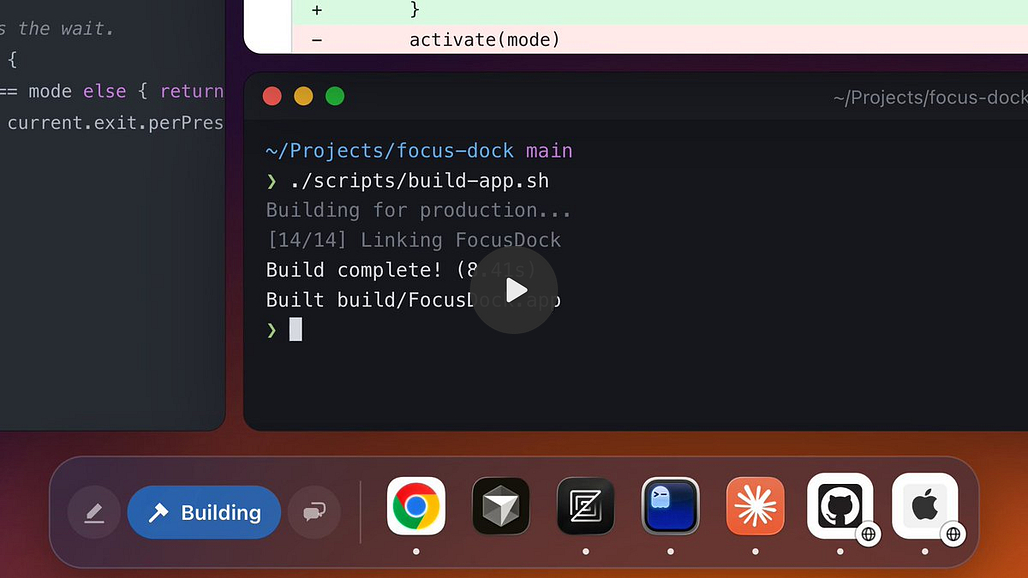
Thariq’s personal project gives the macOS dock custom modes for activities such as writing and building. An agent can change how those modes behave or add new ones, using a tool called jev to classify activity and notifications in real time.
It is a small, concrete experiment in letting software manage interruptions rather than merely display them. The test is whether it makes good enough decisions to earn trust without becoming another distraction.

Polymarket reports Anthropic’s purchase of a solo biotech startup
According to Polymarket, Anthropic has acquired a one-person biotech startup that used Claude to coordinate 11 laboratories developing experimental treatments for rare childhood diseases. The supplied post does not name the startup or provide acquisition terms.
The reported laboratory coordination is notable in its own right. But coordinating research, developing an experimental treatment and proving that treatment safe and useful are distinct achievements. The post does not establish clinical results.

The Kobeissi Letter highlights lower death rates at high-AI hospitals
The Kobeissi Letter reports that health systems with high AI use saw deaths fall from roughly 1,600 to 1,000 per 100,000 patients between 2023 and 2026, a decline of about 37.5%. It says high- and low-AI systems began with similar rates.
Those figures deserve attention, but the post alone cannot show that AI caused the reduction. Patient mix, staffing, other care improvements and the definition of “AI use” all matter. The underlying study would be needed before drawing a firm conclusion.


Xi Yan’s Director bot appears in the Grok Bot Marketplace
According to @tetsuoai, Xi Yan’s Director bot takes a brief and handles planning, shooting and editing for short films, adverts, explainers or music videos. It also comes with an importable pack of video skills.
The promise is a single workflow rather than a collection of separate generation tools. What the post does not establish is how well the bot maintains creative direction through revisions, where much of the real production work happens.

Roon questions the value of frontier AI lab equity
Roon, posting as @tszzl, argues that frontier lab valuations are difficult to judge when government-imposed slowdowns or even nationalisation remain possible. These are scenarios he raises, not announced policy decisions.
It is a useful counterpoint to discussions focused only on model quality and revenue growth. An investor also has to make assumptions about who will be allowed to build advanced systems, under what rules and with what ownership rights.

Discord reportedly plans search indexing for public messages
Unusual Whales, citing TechCrunch, reports that public messages in Discord’s “Discoverable” servers could become searchable through Google and other search engines from mid-December. The post says indexing will be on by default for adults in the US and most countries, but its description of exceptions is cut short.
A conversation being publicly accessible is not the same as participants expecting it to appear in a web search. Anyone running or posting in these servers should check Discord’s announcement and settings before assuming how the change applies.

Trung Phan revisits the iPhone’s move to glass
Trung Phan recounts how keys scratched the plastic screen on an early iPhone prototype, prompting Steve Jobs to ask Corning for a glass replacement on a deadline its chief executive initially considered impossible.
It is a fitting hardware footnote to a day dominated by software. A product can look convincing in a demonstration and still need a basic material problem fixed before it belongs in someone’s pocket.


