



Overview
Today’s feed was led by AI politics, markets, and the craft of building with agents. DeepSeek has reportedly hit pause on fundraising, Sam Altman’s “singularity” line lit up prediction markets, and the open-weight debate put fresh pressure on Anthropic. Around the edges, builders shared practical notes on AI coding systems, robotics benchmarks, geospatial tools, and OpenAI’s response to an outage.
The big picture
DeepSeek taps the brakes on new funding
DeepSeek has reportedly paused its second fundraising round, telling prospective investors that no agreements will be signed for now. That is notable because the Chinese AI lab has been treated as a serious frontier contender, with efficient open models and talk of a possible STAR Market listing.
The pause does not mean the round is dead. It may restart later. Still, after reports of a previous $7.4 billion raise and talk of a much higher valuation, this looks like a moment where DeepSeek is choosing control and timing over speed.

The model launch hype cycle is starting to wobble
François Chollet argued that headline-grabbing AI model launches may soon give way to constant, quiet updates without public version numbers. That lands on the same day as Peter Yang pointing readers to a critique of Anthropic’s Opus 5, where benchmark wins did not fully match real-world feel.
The common thread is that model quality is becoming harder to judge from release notes alone. If models are updated constantly, and public tests tell only part of the story, the market will care more about how these systems behave in daily work than what number sits beside the name.

Altman’s “singularity” line becomes market material
Sam Altman’s claim that humanity is “now in the singularity” travelled fast, helped by prediction market accounts turning the line into a trading prompt. Polymarket highlighted an 11% chance that OpenAI announces AGI by the end of 2026.
The reaction was split between belief, scepticism, and jokes, which is probably the right mood. AI progress is real and rapid, but the word “singularity” carries so much baggage that every use of it becomes both a forecast and a provocation.

Open-weight AI puts Anthropic in an awkward spot
The open-weight debate kept gathering names, with Microsoft, Meta, NVIDIA, Google, and OpenAI all tied to support for a letter arguing against broad restrictions. Peter Steinberger summed up the pro-open case neatly: competition helps the ecosystem, and serving models at scale is hard.
Anthropic’s absence is what drew the most attention. For supporters of open models, it makes the company look isolated. For Anthropic, the likely argument is safety and control. Either way, the public divide between open access and cautious release is getting sharper.


OpenAI resets limits after a near-global outage
After a near-global outage affecting ChatGPT, Codex, and APIs, Tibo from OpenAI said limits had been reset for Codex and ChatGPT Work accounts. The tone was simple: things broke, the team recovered, and customers get a reset.
The response was well received because it matched the problem with a practical fix. When people build their workday around these tools, downtime is not abstract. A reset is a small but visible acknowledgement that reliability now matters as much as capability.


AI coding gets more serious about memory
ThePrimeagen shared a practical method for getting better code out of LLMs: keep detailed project notes, log interactions in markdown, include commit hashes, and let the agent build durable feedback over time. The key idea is not magic prompting, it is giving the system a reliable memory of how the codebase works.
Guillermo Rauch made the broader version of the same point, saying the software factory is now the product. In other words, the agents, checks, notes, and repair loops around a product increasingly shape the quality of the product itself.

Drone-Bench brings AI coding into the room
kache pointed people towards Drone-Bench, a robotics benchmark where AI agents write code for small drones running real indoor missions. The tasks include mapping, navigation, detection, and following, which makes it more grounded than another abstract coding test.
The appeal is clear. If an agent can write code that flies hardware through a room without crashing, that says something useful about planning, debugging, and real-world tolerance for mistakes. Robotics has a way of making vague claims concrete.


GeoLibre adds polish for open geospatial work
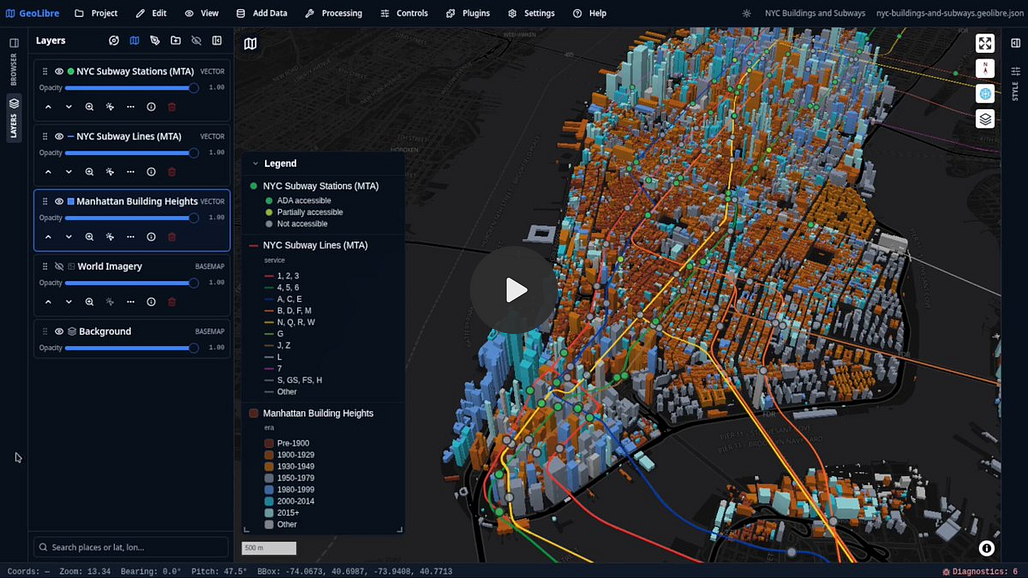
Qiusheng Wu released GeoLibre v2.3.0, adding automatic legends, symbology previews, a GeoLens catalogue browser, time-series tools for cloud optimised GeoTIFF collections, and shareable links for Whitebox geoprocessing tools.
The demo, showing 3D New York buildings and subway data, makes the release feel less like a niche GIS update and more like a reminder that serious spatial analysis is becoming easier to run across browsers, desktops, mobile, and notebooks.

Naval’s simple test for selling
Naval posted a clean rule for commerce: do not sell anything you would not want your children to buy. It is short enough to sound obvious, but it cuts through plenty of grey-area business logic.
The line works because it replaces abstract ethics with a personal test. If the product would feel wrong in your own home, it probably deserves more scrutiny before you ask strangers to pay for it.

Soyuz crew says farewell to the ISS
NASA streamed Chris Williams, Sergey Kud-Sverchkov, and Sergei Mikaev preparing to leave the International Space Station aboard Soyuz MS-28. It was a routine spaceflight moment, but still the kind that makes orbital life feel oddly intimate.
The replies also showed the familiar split between awe and scepticism. Even live footage from space cannot settle every argument online, but the broadcast remains a small window into a human operation happening far above the noise.


