



Overview
Today’s feed sits at the intersection of two anxieties and one big promise: AI is getting stronger (and cheaper to run), but people are wondering what that does to jobs, skills, and even how we judge good work. Alongside the model chatter, there’s a quieter kind of progress too, like satellites spotting fires earlier, and the web inching towards payments that are not just ads.
The big picture
We’re watching a new stack settle into place. AI models are turning into infrastructure, companies are making hard calls about cost and control, and creators are testing what “done” means when machines can draft, edit, code, and even click through checkout flows. The open question is not whether the tools work, it’s whether people, teams, and hiring loops can keep up without burning out or losing their edge.
FireSat adds satellites, and the case for near real-time wildfire detection gets sharper
Sundar Pichai’s update is a reminder that not all AI stories are chat windows. FireSat is about sensors, coverage, and response time, with the pilot already spotting smaller fires that older satellites miss. With more satellites up, the real win is faster alerts for agencies that do not have time to wait for the next pass overhead.
It’s also a neat example of “AI” as a supporting act. The headline is space hardware, but the payoff comes from models that can spot the right patterns in messy infrared data, then route that into something responders can use.


Native web monetisation is back on the table, and it is not ads
Brian Armstrong points to Cloudflare’s Monetization Gateway as a sign the web might finally get a built-in way to charge for access, whether that’s pages, APIs, or datasets. The interesting bit is the mechanics, micropayments and usage-based pricing without the usual account and key sprawl.
If it takes off, it could change how small publishers and toolmakers think about “free”. Less chasing scale for ad inventory, more charging for something people actually want, even if it’s pennies at a time.


The tech workforce splits along AI confidence lines
Lenny Rachitsky’s new survey lands like a cold splash of water. Burnout is up, optimism is down, and there’s a growing identity gap between people who feel strengthened by AI and those who feel their value shrinking.
The detail that sticks is that the dominant worry is workload pressure, not job loss. That fits the mood across teams right now, the tools raise the ceiling, then management quietly raises the floor.


In the AI age, volition becomes the scarce skill
Peter Steinberger shares a line from David Brooks that feels uncomfortably true: when intelligence is plentiful, the deciding factor is who still chooses to wrestle with hard problems. Not who automates their week into a hammock, but who uses the tools to push further.
It also hints at a new sort of inequality, not access to models, but the habit of thinking, checking, and owning decisions rather than outsourcing them.

AI video editing gets real, down to prompts, scripts, and render bottlenecks
Thariq live-tweets his workflow for turning 60GB of raw talk footage into something watchable using Anthropic’s Fable, plus transcription, Python glue, and low-res previews to iterate quickly. It’s the kind of post that makes “AI filmmaking” feel less like a demo and more like a craft, with trade-offs, tooling, and patience.
The subtext is cost and limits. People are excited by the output, then immediately run into quotas, which is becoming its own genre of creative constraint.


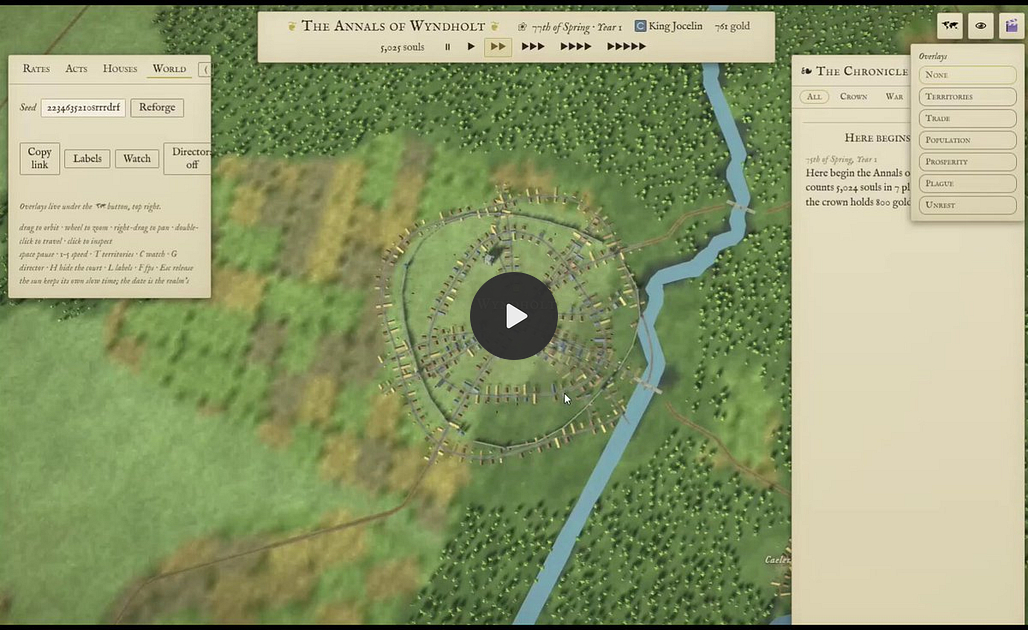
Fable builds a whole fantasy kingdom simulator in a single HTML file
Ethan Mollick’s “Annals” is pure internet joy: an in-browser kingdom generator with economics, wars, lineages, disasters, and the odd dragon, all running without a backend. The prompt discipline is the story here, deterministic seeds, rendering detail, camera direction, and a Chronicle to narrate what’s happening.
It’s also a glimpse at where “apps” are headed when a good prompt plus a competent model can produce a playable world, then iterate based on feedback like any normal product.

Microsoft reportedly routes prompts away from OpenAI and Anthropic to cut costs
Polymarket flags reporting that Microsoft has started moving Excel and Outlook prompts from third-party models to its own MAI family. The motivation reads plainly: inference bills are painful at scale, and owning the model means owning the margin.
The risky part is quality. Users do not care who answered, they care if it helps. If the in-house model is even slightly worse, you feel it instantly in a spreadsheet or inbox.

GPT-5.6 Sol gets a date, and early testers are already arguing about who wins
OpenAI says GPT-5.6 Sol (plus Terra and Luna) launches publicly Thursday, with preview access expanding globally now. Within hours, the counter-narratives arrive: some testers call it their best model yet, others say Fable still does more per turn.
This is the new normal, model launches as public sport, with taste, workflows, and pricing all tangled together. The practical question for most people is simpler: which one helps me ship this week?


Interviews after LeetCode: candidates want reality, not memorisation
Yuchen Jin says the quiet part out loud: LeetCode now tests recall more than competence, because even small models can crank through those puzzles faster than humans. What candidates want instead is work that looks like the job, framing problems, using tools, and spotting when the model is wrong.
Standardised tests were useful when we needed an easy filter. The catch is that the filter is now selecting for the wrong thing, and top candidates know it.

“AI-fed, human-finished” becomes a slogan, and also a fault line
Jack Dorsey drops a neat phrase for the current creative workflow: let the machine generate the base, then let a person decide what survives. It sounds simple, but it carries a challenge, the human part has to mean something, otherwise it is just editing noise.
The replies show the split mood. Some see it as the natural next tool. Others hear it as a countdown timer on what creative work is worth.


